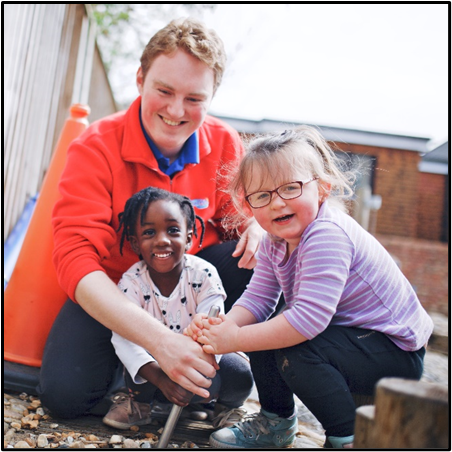
I have heard the Early Childhood Education (ECE) landscape referred to as ‘Nomansland’ (No man’s land), a place virtually devoid of male presence. The facts support this view. It is indeed the case that the majority of countries around the world deem the care and education of our youngest children to be a role exclusively suited to women with some of them unwittingly letting the odd male sneak through in an unguarded moment. World-wide, the typical makeup of the ECE workforce is anywhere between ninety to one hundred percent female, usually nearer the hundred mark in most ECE centres. Men are a rarity in this education sector, more so than in the educational fields serving older children. The younger the children, seemingly the less we all believe in the suitability of men to fulfil the role as carer and educator, which is strange if you think about it since most fathers would consider themselves carers and educators of their children. So maybe we feel that as a man, it’s ok to love, care for, play and teach your own child but not other peoples’ children? Yet we don’t feel the same way about women? I wonder why?
Maybe we’re better off with the status quo. After all, women have been fulfilling this role as teachers of young children ever since Friedrich Froebel advocated for them to do so when he started the first kindergarten in Blankenburg, Germany, in 1840. This was a radical proposal at the time – women as teachers, a role traditionally performed exclusively by men. But the female teacher role seemed to stick after Froebel’s death in 1852 when his philosophies of education and the concept of the kindergarten was exported internationally by his former coworkers. Particularly with respect to young children being educated – those aged 2 to 5 years, the established orthodoxy is that this is a role best suited to women and even more so for those in the birth to 2 years age group. Our notion of maternal care and the protection of babies does not allow for the possibility of entrusting men with this responsibility. Why would men want to?
I have interviewed lots of men who work in ECE over many years. With one notable exception, none of them aspired to work in this area. If asked ‘What do you want to be when you grow up?’ most boys’ choices would not include daycare or kindergarten teacher. Most teachers, parents and careers advisors will not suggest or support the idea of male students choosing a career in ECE. The men I have spoken to typically fall into it by chance – maybe their parent or partner works in ECE and suggests that they come in as a visitor, volunteer or for a work placement.
This is where the magic happens, where men realise that they have something to contribute. In my opinion, there is no greater job satisfaction than experiencing the privilege of forming meaningful relationships with our youngest children, to share their daily activities and input into their development. Not only is there immense fulfilment in supporting children’s development and seeing successive milestones achieved, in the knowledge that you have had a part to play in the progression to the next step, but there is also the reward of the reciprocal relationships that happen every day spending time with one another in the amazing world of children’s creativity, imagination and fun. It is a place of inclusion, tolerance, respect, freedom and laughter – elements that are sadly missing from so many other work environments. Why wouldn’t men want to work here if they knew what the benefits are?
But so what? Just because men might feel aggrieved at their effective exclusion from the ECE world, does it matter that they aren’t there? What are the reasons we might want men? To carry the heavy stuff? To be the outdoors and sporty types? To be disciplinarians? And is there any evidence that suggest men make a difference by their presence?
I would suggest that the best place to challenge the accepted unhelpful gender stereotypes is in ECE. Not all men are strong, sporty or gruff; just as not all women are weak, meek, timid and studious. How are boys and girls meant to figure out what sort of person to become if they are not given opportunities to interact with men and women who convey a spectrum of character types? Don’t we need individuals free to bring the best version of themselves into children’s lives – strong, vulnerable, sporty, gregarious, shy, funny, empathetic, adventurous, wise, compassionate, intelligent, practical…. regardless of gender? And don’t we want our children to grow up in environments where men and women of different races, sexualities and abilities model kind, nurturing and respectful relationships with one another as professional colleagues? How else will our children learn to challenge the iniquities that continue to blight our society – misogyny, racism, lack of tolerance and respect?
In 2017 as part of the research for my book ‘Men in Early Years Settings’ jointly authored with Dr Simon Brownhill, I interviewed ECE providers whose team comprised an above average proportion of men. These were examples of a mixed-gender workforce. I was keen to understand what characterises these centres and what perceived benefits accrue from employing men as ECE teachers.
Below, I reproduce the responses given to my standard set of questions, given by Leanna Barrett, owner of Little Forest Folk Nurseries in south London, England. I believe her comments are insightful and clear evidence of the benefits of a mixed gender workforce. At the time this interview was conducted, Leanna had managed to develop a team comprising 50% women and 50% men – a remarkable achievement.
What characterises the culture in your mixed gender teams? Does the gender make-up of the team make any difference to the culture?
It doesn’t make any difference. We have a balance in each centre. We don’t try to attract men. We try to attract good people. We employ the best person that comes to us to fit the vacancy that we have at the time. It has just happened that over the last couple of years, half of the best people who have applied for these positions have been men. When we first opened in Wimbledon, there weren’t many men working in Early Years in the area. So there was a lot of, ‘Oh, you’ve got men working in your nursery. What about changing nappies?’ There was a lot of that. We would say, ‘This is the way it is.’ Now we just had one of our men resign. He left us at Christmas, and all the parents are saying, ‘I hope you’re going to replace him with another man. We don’t want to have one less man in the setting.’ They’re coming from seeing men as an unknown quantity to now thinking they are an enormous asset to the nursery. That’s an interesting shift in their mental attitude.
What would you say about the sense of professional identity of your team members?
They are all absolutely amazing; they see themselves as part of an incredible team. They feel that they have a purpose. They are very tight knit. No one is working with us because they just want a job. This is their passion. They feel purposeful. They’re not doing this just for money. No one would work in Early Years for money! They feel like they’ve got a calling to a bigger thing, bigger than themselves. They feel like they’re changing the world.
So they feel like they have a status?
Yes, absolutely. Partly because we are a bit different, our parents idolise them. They are like rock stars to the children. They know that they are changing a child’s life. The amount of positive feedback they get makes them so proud of what they are achieving.
What would you say children gain from the experience of being with mixed genders?
They get an all-round balance of society, they learn how to talk to men, they learn how to talk to women, they learn how to interact and to be natural. We don’t have children who are timid around men.
Are the experiences and outcomes for your children any different due to having a mixed gender team?
I wouldn’t like to say that any particular sex affects anything but it is a different kind of play with men. There’s no denying it. It’s a completely different kind of play. Not that all our women are false nails and extensions types; they are out in the forest as well, but it’s a different kind of play. In particular, for the children where we are, they don’t get many male role models. Dads are working full-time. They go early in the morning and come back late at night. These children don’t spend much time with men. To have male role models around is, I think, incredibly beneficial for them. What I love is that they don’t notice the difference between men and women. We try to teach them to not see the difference between children and adults and men and women. Everyone in the setting is equal. It’s amazing to see that they take that on board. I would hate for my own children to be in a setting with only women or only men. I want them to get models for how men and women should behave in society and I want them to learn that first-hand.
Overall, what would you say are the benefits of having a mixed gender team?
It just feels natural, it feels right. We’ve got 50-50 children; why shouldn’t we have 50-50 staff? When you walk into our centres, it feels right.
At a time when ECE centres across the World are struggling to recruit staff, it seems crazy not to be considering the untapped resource of 50% of the working population – men. As you can see from Leanna’s experience, not only can men carry out the duties of an ECE teacher but they can also add another enriching dimension to children’s experience. Why not consider inviting males into your centre? – they won’t come if uninvited. Yours can be a centre that benefits from the presence of a man for all reasons!
 Out of the Pot
Leave a comment